

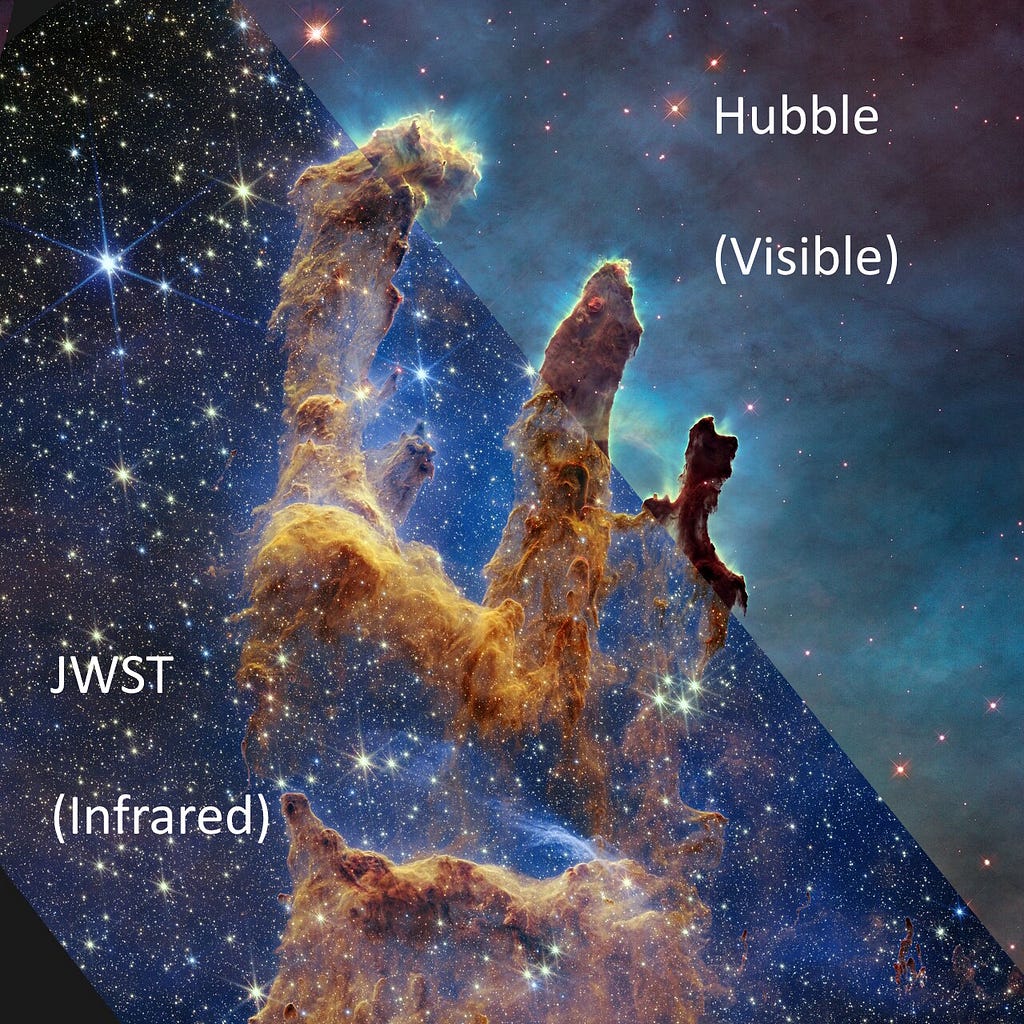

Here in our modern Universe, it’s cosmic dust that forms planets, complex molecules, and enables life. But how did the Universe create it?
Out there in the Universe, we’re most aware of what we see: of all the forms of light that arrive in our eyes, instruments, telescopes, and detectors. Much more difficult to see, as well as understand and make sense of, is the wide array of “stuff” that’s present, but that isn’t readily apparent to the apparatuses we normally use to reveal the Universe. From the dark bands of the Milky Way to the light-blocking materials in nebulae and clouds, all the way to lining the arms of spiral galaxies and the heavy, long-chained molecules found in protoplanetary disks, cosmic dust is perhaps our most enduring mystery.
https://medium.com/media/a019e5cea874b3f52a9f96b4e800c66c/href
Sure, it gives absorption signatures that we can leverage, and at long enough infrared wavelengths, dust that gets heated has its own emission signatures, but we can generally only observe it in detail up close: within our own galaxy or in the nearest galaxies of all. That poses a huge challenge, because the origin of dust, including from a cosmic perspective, remains only very poorly understood. We may have identified many dust-producing sources in the Universe, and we may understand that the young Universe was a lot less dusty than our modern cosmos, but we still lack an understanding of how this has come to be the case. Thankfully, we have scientists on the case, like this month’s guest: Dr. Elizabeth Tarantino of the Space Telescope Science Institute.
https://medium.com/media/6b80c9ec00960b70f1cf4fcc5340a68c/href
In this fascinating interview, she takes us on a journey spanning gently dying stars, the formation of new stellar systems, the outskirts of our cosmic backyard, and to the farthest reaches of JWST as we try and piece this mysterious cosmic story together. Buckle up for an exciting and informative ride; you’ll be glad you tuned in!
Starts With A Bang is written by Ethan Siegel, Ph.D., author of (affiliate links following) Beyond The Galaxy, Treknology, The Littlest Girl Goes Inside An Atom, and Infinite Cosmos. His latest, The Grand Cosmic Story, is out now!
Starts With A Bang Podcast #126 — The origin of dust was originally published in Starts With A Bang! on Medium, where people are continuing the conversation by highlighting and responding to this story.