


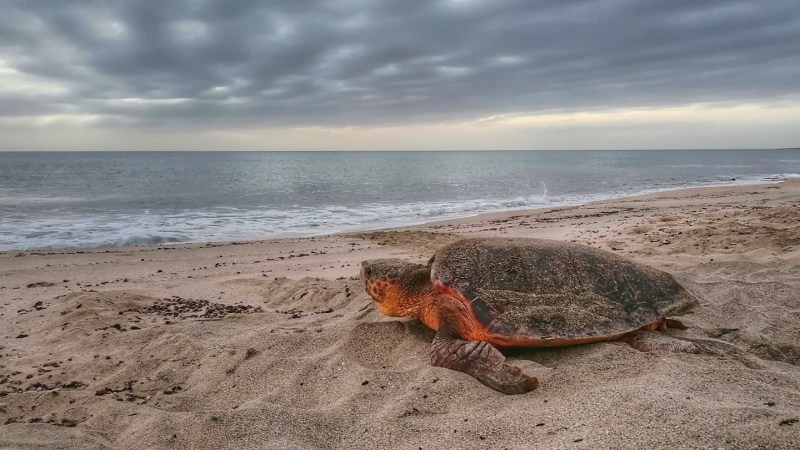
Around the world, many conservationists are celebrating increases in sea turtle population growth. Cape Verde in West Africa now has 100 times as many loggerhead turtle nests each year as there were in 2008. But scientists warn that this apparent success could be hiding an impending population collapse.
Using drone surveys and 15 years of nesting data, scientists at Queen Mary University of London report that booming nest counts could be misleading. As global warming causes temperatures to rise, more sea turtle eggs are developing into females. Without enough males, even a seemingly thriving population can collapse. Their findings, which are yet to be peer-reviewed, were posted January 20 to bioRxiv.org.
“We think that there’s a bit of a mirage,” says Christophe Eizaguirre, a conservation geneticist at Queen Mary University. Conservation efforts, such as marine protected areas, fishing regulations and protecting egg clutches, are helping populations, but may not provide the full picture.
As in some other reptiles, such as crocodiles, a sea turtle’s sex is dependent on the egg’s incubation temperature. Eggs that develop in warmer sand become female, while cooler conditions create males. “The way we describe it in my lab is ‘hot chicks and cool dudes’,” says Jeanette Wyneken, a biologist at Florida Atlantic University in Boca Raton, who wasn’t involved in the study.
Using drones, the scientists photographed the breeding population and found a 9–1 ratio of females to males. “We can differentiate between females and males by the tails,” says biologist Fitra Arya Dwi Nugraha, also at Queen Mary University. “Males have longer and thicker tails.”
It’s believed that a temperature of about 29 degrees Celsius produces a roughly even split between male and female hatchlings. “We don’t know what a perfect population should look like,” Eizaguirre says.
The authors hypothesize that the extreme skew toward female loggerheads (Caretta caretta) that go on to lay eggs inflates the nest count, making the population seem healthier than it is. Without enough males to sustain breeding, population growth could quickly vanish, though it’s hard to predict when this tipping point could arrive.
Wyneken has concerns about the study’s methods, particularly in determining the ratio. Although adult males can be identified by drone, it’s harder to tell with subadult individuals, which can be comparable in size to females. “It’s possible that they are counting some immature males as females,” she says. “The 9–1 may be more skewed than normal if it’s got that error.” It’s more accurate, she says, to confirm hatchling sex through a laparoscopy surgery.
Turtles have evolved strategies to protect against a female bias: Males can mate more frequently than females, females store sperm to maximize how many clutches of eggs they can fertilize and both sexes mate with several partners. Some conservation initiatives relocate eggs to hatcheries to give them the best chance of survival by protecting them from predators, poachers and environmental threats. If something goes wrong, “you’re putting all your eggs in one basket,” Wyneken says.
Having too many females across global populations would be a concern, the scientists agree. “You expect more females,” Wyneken says, but “seasons where we get 100 percent female, again and again and again, or 98 percent female? That’s not sustainable.” These dramatically skewed populations are already popping up in some warmer regions, such as beaches in the northern Great Barrier Reef.
The authors hope that their work will prevent people from winding down conservation initiatives, thinking that they’ve worked. “That’s probably not the case,” Eizaguirre says. Ongoing and adapting conservation efforts are vital in giving turtle populations time to respond to changes in their environment. “What we really don’t want is the effort to stop.”