

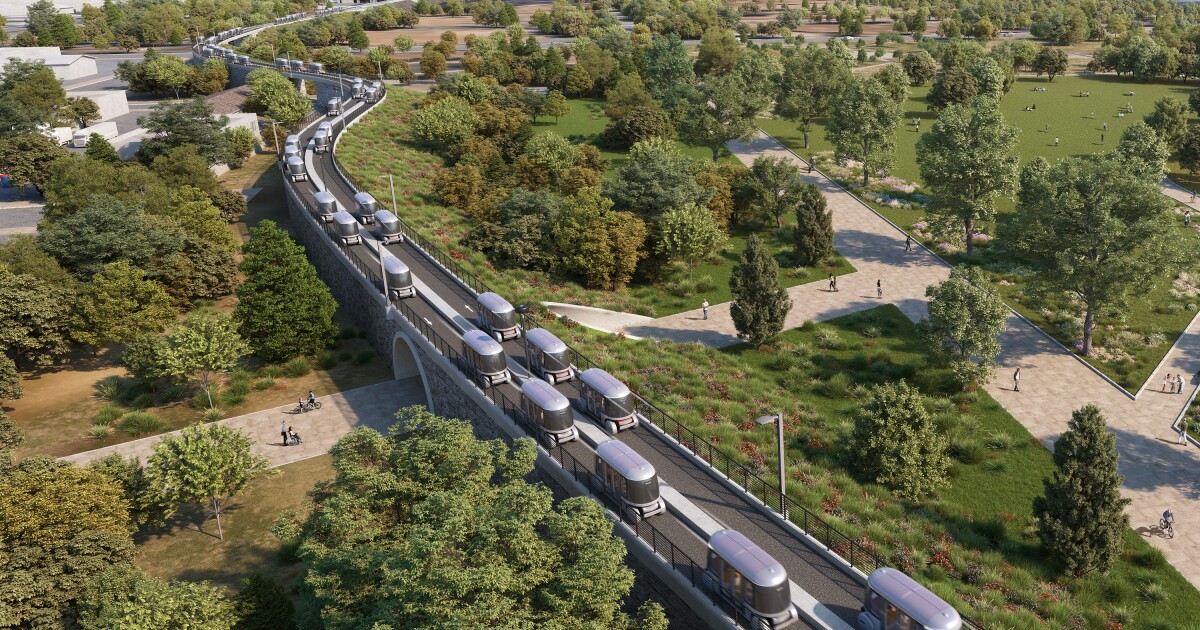
South Metro Atlanta is set to become home to a demonstration pilot for a publicly accessible automated transit network using autonomous electric vehicles on dedicated guideways. This system promises to end nail-biting traffic congestion, delivering a rail-like capacity at bus-fare prices without the traditional cost or construction timelines.
Glydways, the California company behind the technology, broke ground on the pilot loop recently. The initial 0.5-mile (0.8-km) guideway connects the ATL SkyTrain at the Georgia International Convention Center to the Gateway Center Arena, and marks the worldwide debut for the company’s Automated Transit Network system. It’s a free public test service scheduled to launch in December 2026.

Glydways
The company argues that cities need “net-new capacity” – additional transportation bandwidth that doesn’t compete with what’s already there. “Just putting autonomous vehicles on open roads doesn’t actually solve congestion,” Mark Seeger, Glydways’ co-CEO and founder, explained in a recent interview. “In many cities, it makes it worse.”
It’s a pitch that’s gaining traction globally. The company has already signed agreements with Dubai’s Roads and Transport Authority and the Abu Dhabi Investment Office, and held discussions with officials in Tokyo, Florida, California, and New York.

Glydways
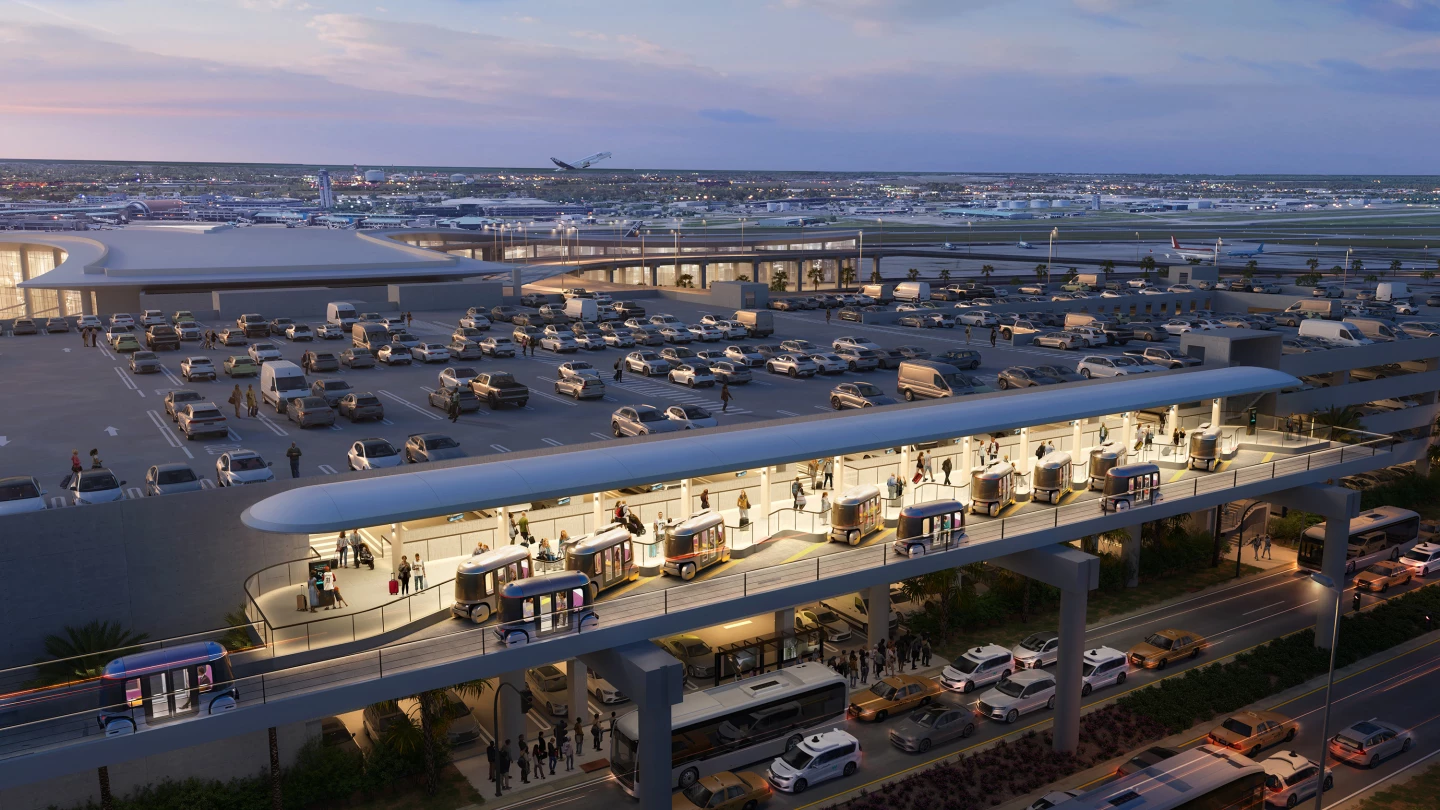
Glydways’ small electric passenger pods run on purpose-built guideways with their own private lanes – not fighting for space with SUVs or getting stuck behind a garbage truck. The system is coordinated by AI software to operate 24/7 on-demand. The idea is that you request a ride via a mobile app, which prompts the arrival of your own vehicle or one shared with your group, and then you travel directly from point A to point B with zero intermediate stops.
The company claims its scaled system has the potential to move 10,000 people per hour through a guideway just 2 m (6.6 ft) wide – matching light rail throughput but without the massive infrastructure costs or decade-long construction timelines. In fact, Glydways says its guideway infrastructure deploys faster and cheaper than traditional rail systems, which can cost hundreds of millions of dollars to realize, though the company hasn’t disclosed specific construction costs for the Atlanta pilot. And because the autonomous passenger vehicles operate on dedicated lanes, they can run at consistent speeds in tight platoons, something that’s impossible in mixed traffic.
The company’s economic model also relies on keeping operational expenses low through having no drivers, utilizing electric propulsion, and undertaking minimal maintenance on a controlled guideway system. And Glydways maintains that unsubsidized operation at bus-fare levels is core to the business model, though actual pricing estimates haven’t been announced yet.
Glydways
The initial Atlanta pilot route will serve as the global proving ground for the system. It connects Convention Center visitors and arena attendees to the existing ATL SkyTrain – a controlled environment with predictable demand patterns, ideal for proving the technology works before scaling up. A feasibility study led by the Metropolitan Atlanta Rapid Transit Authority will evaluate performance and determine whether the system should expand across the broader Atlanta region. If it works here, the model could extend to airport connections, suburban commuter routes, and other high-traffic corridors where traditional rail is too expensive.
“What begins in South Metro Atlanta is designed for the world,” said company CCO, Chris Riley in a press statement. “This pilot demonstrates how an innovative new form of public transit can expand access, improve reliability, and help cities move more people without expanding roads or relying on legacy systems.”
The real test isn’t the technology – autonomous vehicles on dedicated lanes is fairly straightforward engineering. The test is whether the economics hold up at scale. Rail-like capacity at bus-like costs sounds great on paper. Whether it pencils out in practice or everything ends up like the Simpsons’ Monorail episode is what the Atlanta pilot will help determine.
Source: Glydways