

What do nine-time Grammy-winning billionaire Rihanna, stunning beaches, and a potential 50-megawatt wave-energy project have in common? Barbados! The island nation is deploying a unique type of wave energy technology to convert its renowned ocean waves into sustainable electricity and freshwater.
The government of Barbados, through its agency Export Barbados, has signed a Memorandum of Understanding (MoU) with Danish firm Wavepiston to launch a 50-MW commercial wave-energy pilot.
The deal, which comes after months of a pre-feasibility study on the island, marks the transition of Wavepiston’s proprietary wave energy system from feasibility to project development. “This marks an important step forward in our journey towards commercial deployment in the Caribbean and positioning Barbados as the regional light-house of wave energy,” Wavepiston said in a press statement.

Wavepiston
Ocean waves hold tremendous kinetic energy, enough to shape entire landscapes over time. The US Energy Information Administration (EIA) estimates that the annual energy potential of waves off the coasts of the United States could reach 2.64 trillion kilowatthours. That’s more than 60% of the total US utility-scale electricity generation.
What’s more, waves are significantly more dependable than the sun and wind, which set and fluctuate, respectively. Unsurprisingly, numerous projects are exploring ways to capture this untapped energy using a variety of technologies. According to the EIA database, over 200 marine energy technologies are currently active. Yet, only a small handful have progressed to the level of development achieved by Wavepiston.
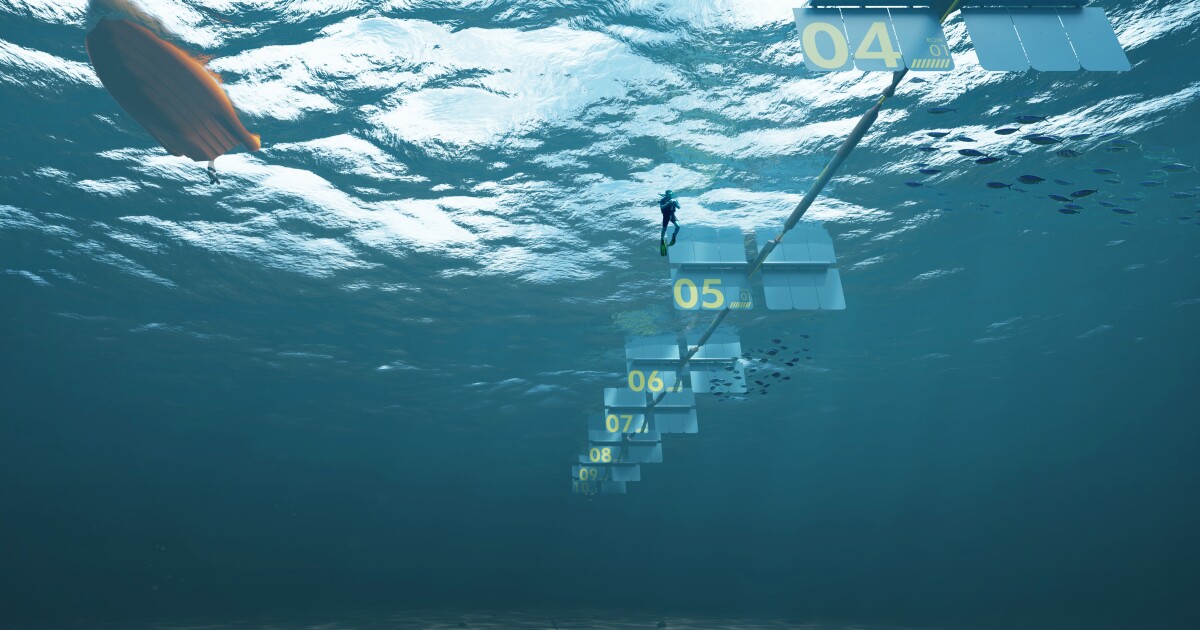
Wavepiston’s technology is a modular offshore wave energy system that converts the constant motion of ocean waves into both clean electricity and desalinated drinking water. At its core is a long, flexible string, typically around 350 meters (1,148 ft) in length, anchored offshore and fitted with multiple energy collectors spaced along it like beads on a wire.
Each collector is equipped with a small underwater sail that moves back and forth as waves pass. This oscillating motion powers an integrated hydraulic pump inside each unit, pressurizing seawater. The pressurized water is then channelled through pipelines to a central conversion station, located either onshore or offshore, where it drives a standard hydropower turbine for electricity generation or feeds into a reverse osmosis system to produce fresh drinking water.
Animation of the Wavepiston system incl. subtitles
The system is intentionally engineered to be simple, robust, and modular, making it able to withstand harsh offshore environments without breaking. Its modularity allows it to be scaled up or down, depending on a community’s energy or water needs. A single installation can consist of just a few strings or be scaled up to hundreds of strings in a wave energy farm, all feeding pressurized seawater to a shared conversion hub.
Because each collector operates slightly out of phase with the others as waves travel along the string, the system produces a steady flow of pressurized water, rather than sudden bursts of energy typical of many wave energy devices. The arrangement also creates a force-cancelling effect, where the push and pull of waves on different parts of the string balance each other, reducing strain on the mooring system and keeping the overall structure lighter and more cost-effective.

Wavepiston
As with any offshore installation, Wavepiston’s system has to meet the crucial environmental impact criterion. What would be the point of generating clean energy to protect the environment, while also damaging the environment? Thankfully, testing has shown no negative effects on marine ecosystems, with some sites even seeing increased marine life around the installations.
While Wavepiston’s 2026 MoU marks a significant step towards commercial deployment, the technology has been under development for decades, with the company’s first-ever patent granted in 2009. It is important to note that the aim of the collaboration with Barbados is not a full-scale utility project, nor is it an experiment. Rather, it’s somewhere in between – a flagship project aimed at proving the bankability, consistency, and durability of the technology ahead of commercial-scale deployment.

Wavepiston
For Barbados, the partnership aligns with its ambitious green transition goal of achieving net-zero by 2030. The Caribbean nation has already proven its commitment to this goal through significant investments in utility-scale solar, wind, and battery storage projects across the region.
“Together with Export Barbados (BIDC), we look forward to consolidating this partnership and advancing the country’s net zero aspirations by delivering on this 50-MW commercial target,” Wavepiston said.
Beyond clean energy and potable water, the project aims to increase local labor opportunities, support long-term energy resilience, and position Barbados as a regional hub for wave energy.
Source: Wavepiston