

We’re one year in, and President Trump’s second term has already produced a parade of problematic historical analogies. Critics have invoked King George III and the Revolutionary War (“No Kings!”), flirted with comparisons to Nazi Germany (subtlety has never been our strong suit as Americans) — and lately have escalated to invoking the Civil War.
For years, I treated casual talk of an impending “civil war” the way one treats urgent predictions of the second coming: colorful, misguided and unlikely to ruin my weekend plans.
Besides, for Americans, the Civil War evokes specific imagery: blue and gray uniforms, epic mustaches, and a tidy geographic split between the North and South. It’s harder to imagine how that template translates to a 21st century America.
Lately, though, the rhetoric has begun to feel less far-fetched. Perhaps that helps explain why a 2024 film titled “Civil War” found an audience (or, at least, got greenlit).
And since that movie’s debut, the civil war analogy has only grown more plausible.
Minnesota Gov. Tim Walz, for example, recently compared ICE-related protests in Minneapolis — marked by violence that resulted in the deaths of two American citizens — to Fort Sumter, the flashpoint that turned America’s most profound moral disagreement into outright war.
Perhaps Walz was engaging in hyperbole, but the Civil War comparison reflects something real: Americans are increasingly and fundamentally divided over rival visions of identity, patriotism and national character.
These grand narratives aren’t merely campaign talking points, meant for public dissemination. Their real potency lies in the private mythologies activists tell themselves. Such stories offer moral certainty, historical purpose and the intoxicating sense that members of a movement are playing a starring role in a grand historical drama.
For example, on parts of the American right — particularly among younger men — a romantic mythology has emerged, built from antique ideas of honor and masculinity and a conviction that the nation has squandered its inheritance (“this is what they took from us”).
It is politics powered by grievance and nostalgia for an imagined past, often casting immigrants as convenient antagonists in a drama about national decline.
Naturally, powerful narratives produce equally powerful counternarratives.
I’m writing this just outside Harpers Ferry, W.Va., where abolitionist John Brown launched his 1859 raid on a federal armory as part of a plan to free enslaved people.
Brown remains one of the most complicated figures in American history — a man admired for recognizing slavery’s moral evil — and condemned for attacking federal property after playing a role in the murder of five pro-slavery men in Kansas.
Even in these parts, Americans still debate whether Brown was a heroic “freedom fighter” or (as Kristi Noem, the secretary of Homeland Security, might put it) a “domestic terrorist.” Possibly he was both, in that grand American tradition of multitasking.
Most abolitionists in the runup to the Civil War, it should be noted, managed to oppose slavery without raiding federal armories or killing anyone. They were people who cared deeply about ending a savage and immoral practice. And along those lines, modern protesters are increasingly being compared to 19th century abolitionists.
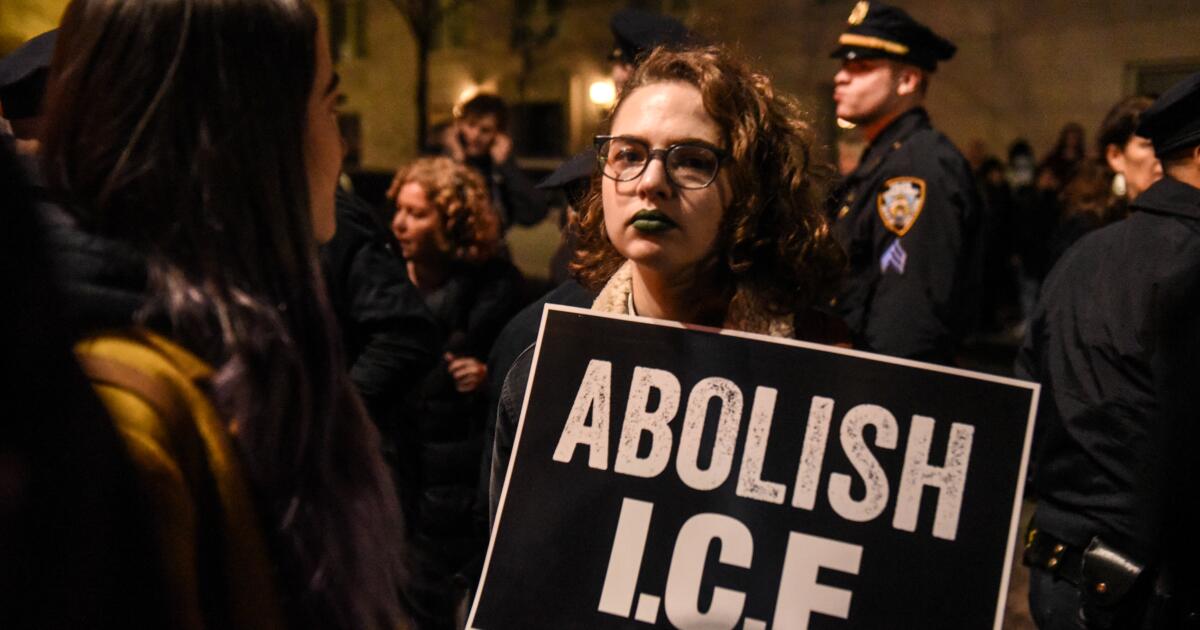
The analogy isn’t purely rhetorical, even though some protesters quite literally want to abolish ICE. The parallels have to do with morals and tactics. Adam Serwer of the Atlantic has suggested that activism in Minneapolis resembles protest movements “we haven’t seen maybe since the 1960s, maybe not since the abolitionists.”
The comparison grows more intriguing when one considers the Fugitive Slave Act of 1850, which empowered federal authorities — and even private citizens — to capture people thought to be fleeing slavery and return them to bondage.
As writer Ta-Nehisi Coates has noted, many “white people were willing to put their bodies on the line” to physically protect their neighbors.
Which raises an uncomfortable possibility: Walz may simply have the wrong historical timestamp. Instead of harking back to the 1861 battle at Fort Sumter, the better analogy for Minneapolis might be the more chaotic and combustible 1850s that made Fort Sumter possible.
Jeff Mayhugh, the president of No Cap Fund, a group dedicated to improving representation by uncapping the number of lawmakers in the House, believes that beneath the shouting, tear gas and viral videos, the unrest in Minneapolis is about power.
“The argument from the right,” Mayhugh says, “is that since immigrants are counted for purposes of apportionment in the House, sanctuary cities inflate representation in blue states.”
Viewed through that lens, Minneapolis echoes antebellum flashpoints like Bleeding Kansas, where national divisions (with national consequences) erupted into local guerrilla warfare.
Years from now, will we look back at Minneapolis and see our era’s Bleeding Kansas, or will this too pass? It’s too soon to say whether the Civil War analogy is illuminating or overheated.
We can all hope it’s the latter.
What is clear, however, is that Americans are no longer debating conventional public policy. We are debating identity — what America is, who it belongs to and whose story will be taught to our grandchildren.
Matt K. Lewis is the author of “Filthy Rich Politicians” and “Too Dumb to Fail.”