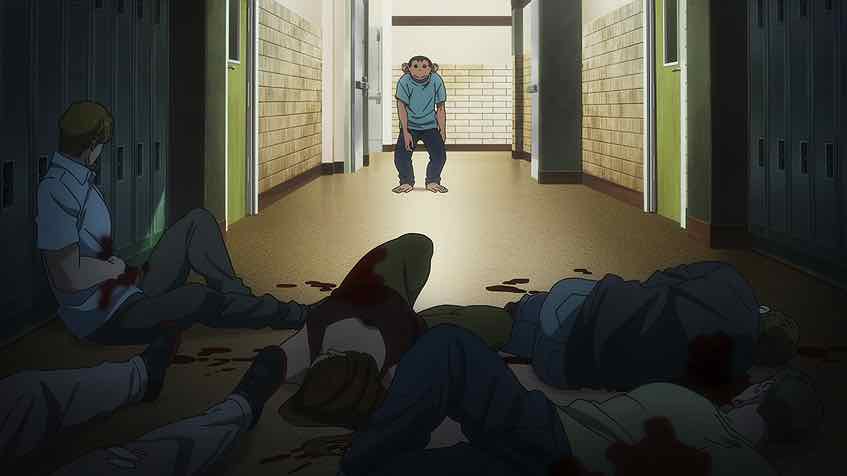
 Not for the first time (or the last) with The Darwin Incident, the chapters this episode was based on left me feeling quite bemused. In a certain sense, the series seems to be checking off a laundry list of cliches about exurban America. Fat cops, belligerent airhead students, racists – could a school shooting be far behind? There was a decent stretch where I was pretty sure Darwin Jihen was anti-American. Just as there was when I felt it was anti-vegan. But over time my view of it evolved, and I think that narrow interpretation misses the point.
 There are different ways one can look at this episode, and the ones that preceded it. As an American, I can be angry about it. I can (accurately) call out the inaccuracies in the series’ depiction of the country. But there are some ugly truths that undercut righteous indignation. I mean, look at who gets elected to the highest office. Look at the gun violence statistics versus every other first world country. If someone from the outside wants to question our priorities, are we in any position to cry foul? Yet because it is an outsider one instinctively does get angry about it. This is the essence of the “rally ’round the flag” syndrome.
 Another response would be “consider the source”. No, we don’t have school shootings here and gun violence is almost (but only almost) non-existent. But this country does have a xenophobic government that rode an eerily familiar wave of racist anti-immigrant rhetoric to an election landslide (with some help from an incompetent opposition). It does have a long history of ethnic persecution and atrocity apologism. None of that is to say someone from such a country isn’t allowed to criticize a different one. But black pots and black kettles and all that.
 In the end, as I said earlier, I think this series is kind of anti-everything. There are good people everywhere, but they’re in the minority. And Charlie is a cipher, impossible to categorize. Which is really the essence of the story, I think. He’s rather peripheral to much of this episode as the focus is on Gale, the “Red Pill Channel” kid with a passion for animal rights as he sees them. Feyerabend taking an interest in him isn’t going to be good for anybody, that much is obvious. Gale is a purely disposable tool to him, his zealotry making him a breeze to manipulate. And he matters because of his access to Charlie, who’s the one Feyerabend actually cares about.
 Feyerabend’s interest in Charlie as framed here makes perfect sense. Animals do, as he says, lack the capacity to band together to fight for their rights. They lack the capacity to make their case with words. Charlie keeps saying he’s just one animal, but the hard truth is he’s a unique one. Whether he wants to be or not, he’s uniquely positioned to be a symbolic figure at the head of a movement.That he wants no part of it is certainly understandable, given who these people are. But that doesn’t mean he has the option to completely recuse himself from involvement as a war heats up.
 The events here pretty much speak for themselves. I don’t know if this kind of sensationalism is good for Darwin Jihen’s credibility – in fact I’d say it isn’t. That is, if it’s really interested in being a serious cultural and political advocate. If it just wants to be a thriller that’s another matter, and the fact that something like this is low-hanging fruit doesn’t matter so much. Hypocrisy, gun violence, yeah – Americans have those in plenty. But hey, nobody’s perfect. And if the series is trying to make a serious statement and not just take easy potshots, sometimes it’s easier to do that by moving the story somewhere “outside” – be that fantasy or in the real world.