

Grow Remote went to the Oireachtas yesterday. Here’s what happened.
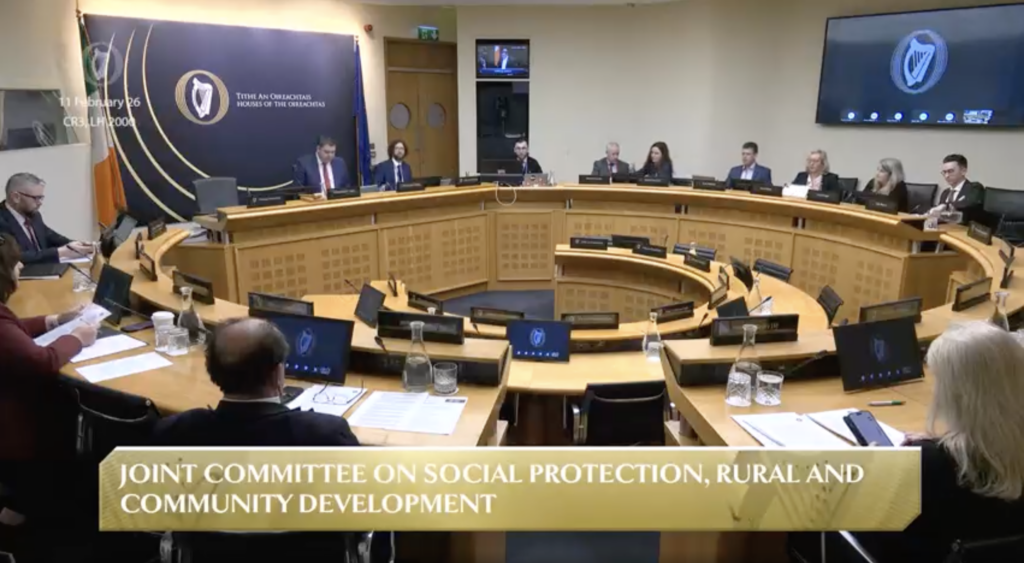
Yesterday, Tracy and Eoin sat before the Joint Committee on Social Protection, Rural and Community Development to make the case for something Ireland has never done before: set a national target to win remote jobs.
The problem we laid out:
Remote work doesn’t just happen. Companies need real support to embed it properly. As Eoin told the Committee, ask any business owner to run a successful business and it’s hard enough. To do so remotely, having never done it before, is twice the challenge. Too many employers still associate remote with the bad years of COVID and don’t realise the supports exist to help them make the transition.
But when companies do get it right and roles become genuinely remote, a bigger question opens up: how does Ireland actually win those jobs? And once they land here, how do we get them deeper into our communities?
Right now, there’s no answer to either question. No system. No target. No delivery mechanism.
We told the Committee that needs to change.
Why now?
The momentum behind this has never been stronger. Last month, 31 TDs from 7 parties stood up in the Dáil to speak about remote work. Over 8,000 people responded to the government’s consultation. The All-Party Group on Remote Work is actively engaged. And Ireland takes over the EU Council Presidency later this year, a once-in-seven-years opportunity to shape European policy on remote employment.
As we review the right to request through the All-Party Group, we recognise that mandating companies could have a detrimental effect on remote work. The better question isn’t how do we force employers to offer remote work. It’s how do we grow the supply of remote jobs so that more people have access to them. That’s a fundamentally different approach, and it’s one that works for employers and employees alike.
Eoin laid out three pillars to make it work.
Community. Ireland has built incredible infrastructure through the national hub scheme. But hubs alone don’t solve isolation or create careers. Remote work needs to be embedded within communities, so workers can volunteer locally, connect with neighbours, and put their time and income back into the places they live. (p.s join up to a local community here: https://growremote.ie/community/)
Employer supports. Companies need training and consultancy to make remote or hybrid actually work. Grow Remote already runs these programmes, but demand outstrips what we can deliver every single year. Scaling that up means more employers come on the journey, and more jobs open up.
The jobs. This is the pillar that brings the other two together. Because we can’t talk about the benefits of remote work without talking about the remote jobs themselves. That means setting a national target for remote employment, from both indigenous Irish companies and the international roles that are, as Eoin put it, “essentially hanging in the air” while Ireland makes no concerted effort to draw them down. And it means tracking those jobs, embedding them in communities through the hub network, and showing employers that there are skilled remote workers in every corner of the country.
Jobs, community, and skills. That’s how the silos connect.
The numbers back it up.
Over 100,000 remote jobs are advertised across Europe every month. 90% of job traffic on LinkedIn flows toward remote roles, but only 10% of postings are fully remote. The pool is enormous and growing.
On our side, we have 30,000 community members, 3,000+ people trained through our SOLAS and LOETB partnerships, and remote-first employers already signing Letters of Intent to ring-fence roles for Irish workers.
What’s missing is the delivery mechanism to connect supply with demand, systematically, across every county.
We brought the stories to prove it works.
Joe, who lived on an island of 60 people and had to leave every Monday for work. After training, he got a full-time remote role. The island school stayed open.
Patrick, working a €130,000 multinational role from a crossroads town with a pub, a shop, and a GAA pitch. That income now flows straight into his local economy.
Indra Cawley, who couldn’t find work matching her skills in Mullingar because those jobs only existed in Dublin. Remote work changed that.
We have 97 pages of stories of impact like this.
The response was encouraging, and the conversations afterwards actionable.
Committee members engaged seriously with the supply-side approach. They asked for specifics on how we could deliver it. They recognised that when 200 remote jobs land across rural Ireland, nobody tracks it and nobody gets credit, and that Ireland needs a system to change that.
One Deputy put it perfectly: politicians get a “red ribbon moment” when a factory opens. Remote jobs deserve the same recognition, because they deliver the same impact.
What happens next?
We keep building. More employer conversations. More training. More evidence. We set the target, and design and build the delivery mechanism.
Back the change: