

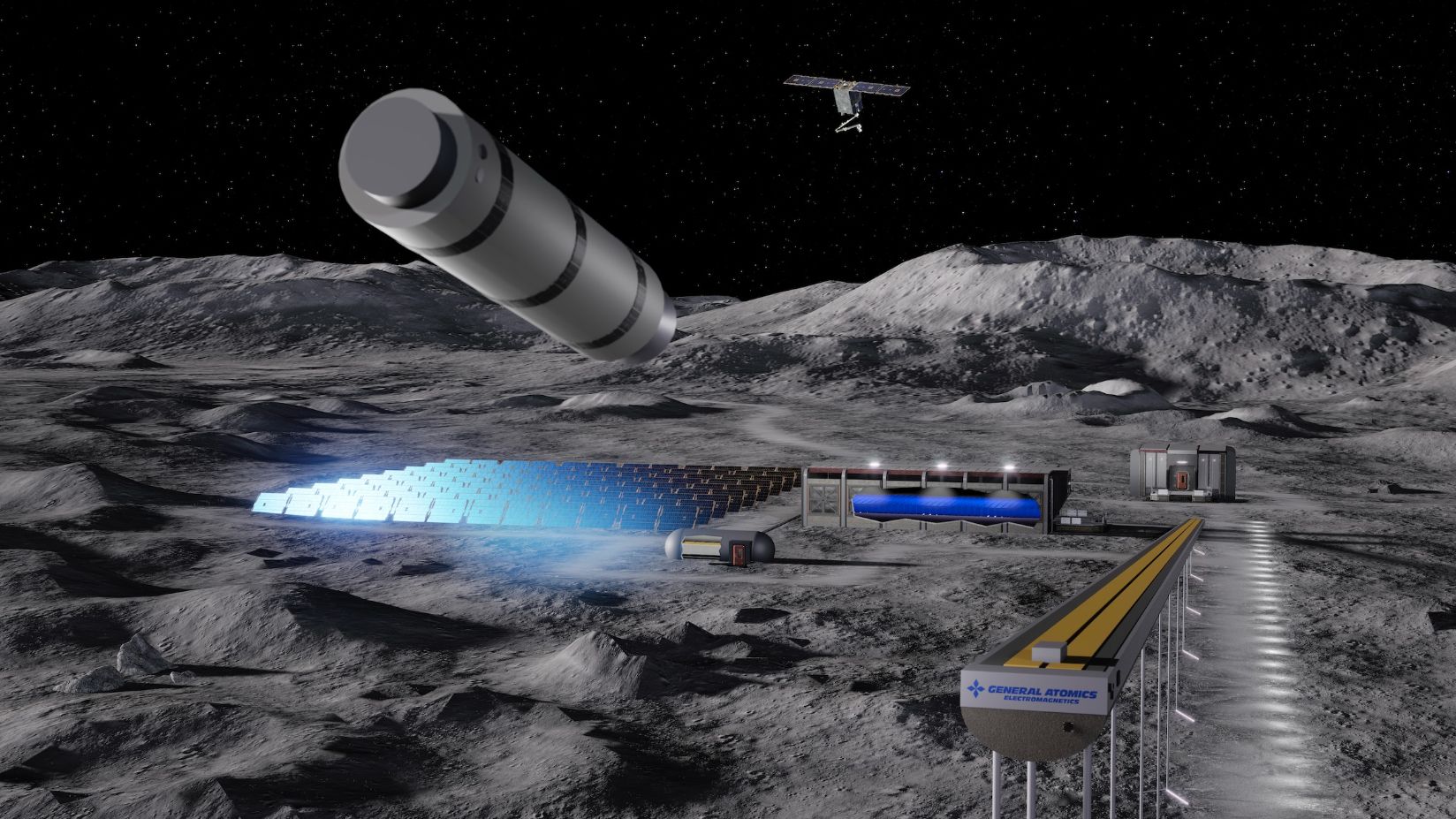
Last week, SpaceX founder Elon Musk advised workers at the newly acquired company xAI that he wants to set up a factory on the moon to build artificial intelligence (AI) satellites. And he called for a colossal catapult on the lunar surface to fling them into space.
“My estimate is that, within two to three years, the lowest-cost way to generate AI compute will be in space,” Elon Musk wrote in a Feb. 2 update that announced SpaceX‘s acquisition of xAI.
Since xAI was formed just 30 months ago, the small and talented team has made remarkable progress.The future has never looked more exciting! pic.twitter.com/QZ73H2mpBjFebruary 11, 2026
Moon cargo
“Thanks to advancements like in-space propellant transfer,” Musk wrote in the Feb. 2 update, “Starship will be capable of landing massive amounts of cargo on the moon. Once there, it will be possible to establish a permanent presence for scientific and manufacturing pursuits.”
Factories on the moon can take advantage of lunar resources to manufacture satellites and deploy them into space, Musk added.
“By using an electromagnetic mass driver and lunar manufacturing,” he wrote, “it is possible to put 500 to 1000 TW/year [terawatts per year] of AI satellites into deep space, meaningfully ascend the Kardashev scale and harness a non-trivial percentage of the sun’s power.”
Mass drivers
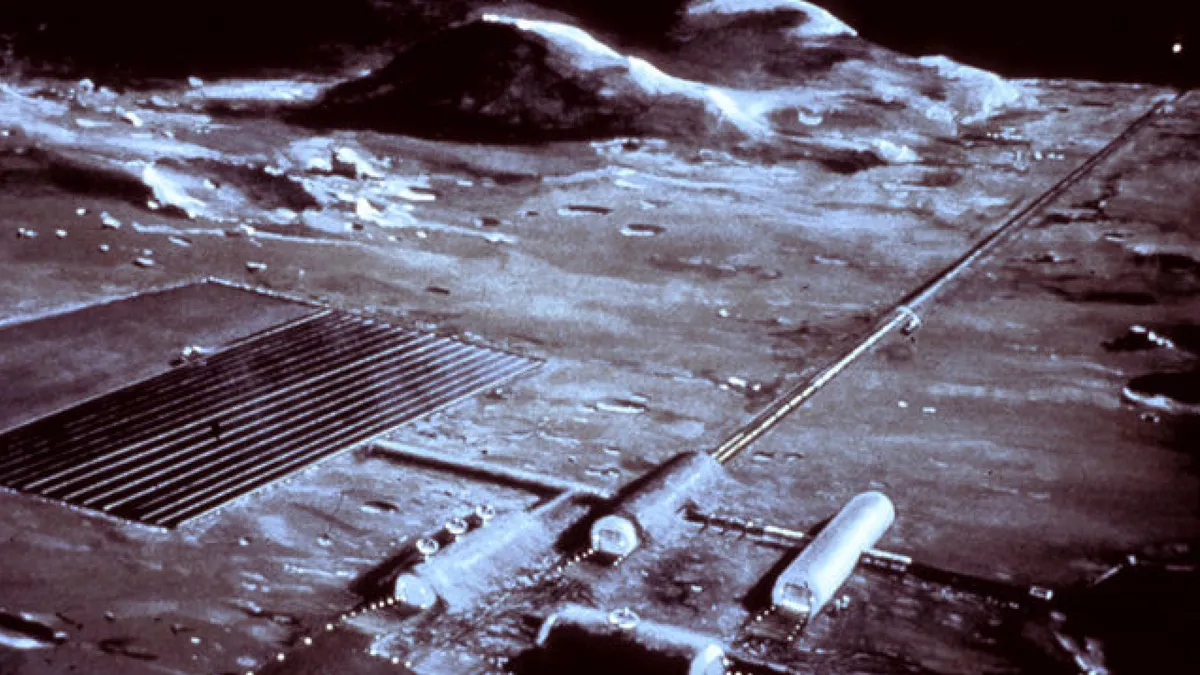
Musk isn’t the first person to propose the use of mass drivers — which are basically railguns — on the moon. He’s following in the footsteps of space visionary Gerard O’Neill, who floated the idea back in 1974.
“Mass drivers” based on a coilgun design can be adapted to accelerate a non-magnetic object. One application O’Neill proposed for mass drivers: toss baseball-sized chunks of ore mined from the surface of the moon into space. Once in space, the ore could be used as raw material for building space colonies and solar power satellites.
O’Neill worked on mass drivers at the Massachusetts Institute of Technology (MIT), along with colleague Henry Kolm and a group of student volunteers to construct their first mass driver prototype.
Backed by grants from the Space Studies Institute, later prototypes improved on the concept, showing that a mass driver only 520 feet (160 meters) long could boost material off the lunar surface.
Kolm, O’Neil, and the student researchers demonstrated a laboratory system that they believed could scale to an operational lunar mass driver several kilometers long to deliver 600,000 tons per year to one of the Earth-moon Lagrange points.
Superior choice
Robert Peterkin of General Atomics Electromagnetic Systems bolstered the promise of lunar-based mass drivers more recently. In 2023, he filed a report to the Air Force Office of Scientific Research (AFOSR) titled “Lunar Electromagnetic Launch for Resource Exploitation to Enhance National Security and Economic Growth.”
“The U.S. government should fund an evolution of the existing electromagnetic aircraft launch system, now operating reliably on the U.S. Navy’s Gerald R. Ford nuclear aircraft carrier, to achieve higher speed, at lower mass, for reliable lunar launch,” said Peterkin.

Lunar ecosystem
“Undoubtedly, the first spiral of a development cycle for a lunar ecosystem will rely on supply of machinery, structures and supporting systems from the Earth,” Peterkin wrote in his AFOSR report.
“A SpaceX Starship with the ability to deliver 100 metric tons to the lunar surface will be a true enabler,” he added. “SpaceX and NASA are developing plans to establish a lunar base of operations, and we recommend that this base be selected to allow for a reliable and enabling lunar electromagnetic launch system.”
Underscored in the 30-page document is that the moon is rich in useful resources, including silicon, titanium, aluminum and iron. The prospect of tapping into lunar water also looms large.
“A not-too-distant future lunar economy will make use of these lunar resources to resupply, repair and refuel spacecraft in lunar orbit at lower cost than delivering terrestrial resources from Earth’s deep gravitational well,” Peterkin wrote in the report.