


©ヤマシタトモコ・祥伝社/アニメ「違国日記」製作委員会
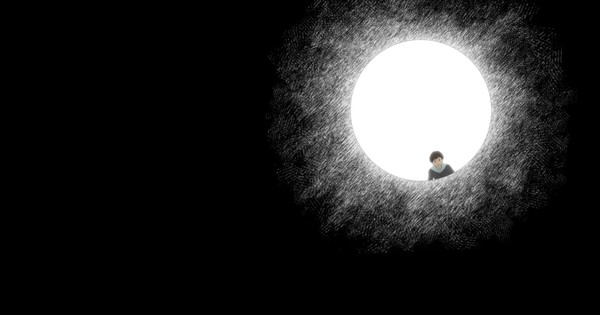
Yet again, I need to catch my breath after finishing a Journal with Witch episode, but this time it’s for entirely different reasons. If last week’s installment was buoyed by the tactile sensations of infatuation, this week’s is weighed down by darkness. I mean that in the psychological sense, but the adaptation turns it literal as well. Several of the most striking scenes here are rendered with dark or pitch black backgrounds. Minori finds herself in a black void with neither her sister nor her own self willing to pull her out of it. Emiri watches Fried Green Tomatoes alone in a dark room. And Asa finds herself staring into the same bottomless pit that consumed her mother.
Kasamachi also contends with darkness, and his portion of the episode surprises me the most. Since it is based on a josei manga, I happily anticipated the series’ focus on the complex interiorities of its female characters. We don’t get enough of that in anime. At the same time, however, we also rarely get to see an adult male character like Kasamachi wrestle so frankly with depression. While the reasons for this would warrant an entire gender studies class, the short version is as such: because it is not “allowed” by patriarchal society. Men are not supposed to succumb to and express weakness or vulnerability. They are supposed to be strong and unwavering. Kasamachi tells himself as much in the middle of his sadness, frustrated that he is unable to “get over it” like somebody his age and gender should. He’s ashamed to be needy.
While Kasamachi’s recollection to Daigo is a small part of the episode, I find it incredibly powerful. These are thought patterns that were drilled into me at a very young age. I remember beating myself up and feeling similarly ashamed and alone when grad school overwhelmed me. I’m finally in the process of unlearning a lot of these habits, having only recently become acutely aware of them (turns out therapy and transitioning can help with that). But I hope other viewers raised to reject emotional honesty can look at Kasamachi and realize it doesn’t have to be that way. Even after he recovers, Kasamachi fears that Makio will judge him for not meeting these ridiculous standards of “masculinity.” She doesn’t, and neither does Daigo. Nobody should.
In truth, we all apply irrational expectations onto ourselves and others, and this is as corrosive as it is ubiquitous. Minori did it, too. Her specter is at its most sympathetic this week, as Emiri’s mom Michiko provides another point of view unladen by familial familiarity. She instead saw a fellow mother who was too hard on herself. The narrative, thus, invites us into the parts of Minori’s memories that were not tied to her being a mother or sister. She feels left behind by her friends. She’s shocked and confused by her partner’s refusal to marry. She, similar to Kasamachi with masculinity, internalized and policed what a woman is “supposed” to be. She’s supposed to marry. She’s supposed to have a child with her husband. She’s supposed to be normal.
Externally, Minori’s insistence on so-called normality eroded her relationships with her sister and daughter. Internally, we can see that her judgmental tendencies were a projection of her own insecurities. And the tragic irony, as is often the case, is that Minori pushed away people who could have helped her. Makio was her window into more nontraditional womanhood, although we see how that, too, comes with insecurities that caused Makio to lash out in turn. Mirroring Makio’s current visions, Minori would also conjure up images of her sister scolding her and critiquing her for her supposed lack of interiority. Minori refuted this by imitating Makio and writing a journal meant for her daughter. But she was not used to doing so, and her words lacked the frankness and clarity of Makio’s incisive observations about the human condition. Minori’s words were a desperate incantation to drive away her own darkness, and in doing so, they betray the same darkness that Asa peers down into.
Asa subconsciously retains some of her mother’s preoccupation with normalcy. This week, it manifests in her conversation with Emiri, where to her friend’s consternation, she keeps drawing parallels between Makio’s weirdness and Emiri’s. Compared to Asa, Emiri is more receptive and nonjudgmental when Makio’s trouble focusing and remembering becomes the topic of conversation. She actually uses the terms “neurodivergent” (I wish I could hear what the precise Japanese word used is), which I must admit makes me feel better about my spiel last week. Combined with Kasamachi’s open discussion of his depression, it is refreshing to watch an anime discuss mental health so unambiguously.
Emiri’s receptiveness of and sensitivity to “weirdness” make sense, too, given that we now definitively know she is grappling with her sexual orientation. When Asa teases her about wanting a girlfriend instead of a boyfriend, the camera moves to Emiri’s point of view, where we notice how her eyes stare off into the distance rather than focus on her phone. It’s a sublime and subtle way for the adaptation to communicate her flash of panic. More heartbreakingly, we watch a flashback of her crying at Fried Green Tomatoes while in the present, she denies being or acting strange. Asa thinks she is joking around with her best friend, and we aren’t given any reason to suspect she’d attack or abandon Emiri for being a lesbian. Nevertheless, Asa’s chidings are a manifestation of the background radiation homophobia that makes it difficult for Emiri, or anybody, to exit the closet. I’m praying for this gay baby.
Thankfully, this episode is not all doom and gloom, and it makes plenty of choices I can objectively admire. I love how the first half blends both restaurant conversations together with seamless cuts, as if they are two parts of a single scene. This invites the audience to draw subtler parallels than we might have drawn otherwise, or to imagine how one question or response can possess multiple layers of meaning. Given that Kasamachi and Makio are now romantically involved (again), I appreciate that Journal with Witch brings Daigo back to remind us that men and women can indeed have platonic friendships. Makio’s dialogue with Michiko feels similarly potent. While their views on parenthood don’t perfectly align, Michiko in particular feels liberated by a conversation partner who doesn’t view her primarily or exclusively as “Emiri’s mom.” Anime moms are rarely afforded this kind of friendship.
Still, the notion of motherhood hangs over the entirety of Journal with Witch, like uncertain clouds that might unleash a torrent of rain at any moment. Makio rejects motherhood, admitting only to being Asa’s guardian, nothing more. Michiko seems to have a solid grasp on motherhood, but that may become more complicated after Emiri comes out. Minori felt overwhelmed and isolated by the pressures of motherhood. Kasamachi weighs the affection Makio notices within his mom’s bento journal against the “perfect son” ideal he felt thrust upon him.
Motherhood is not a state of being; it is a relationship that cuts both ways, scarring all of us, parent and child alike, to different degrees. If there is such a thing as a solution contained within Journal with Witch, I think it lies in the story’s rejection of assumptions, expectations, and stereotypes. Layer by layer, the writing strips these characters down to their authentically messy and vulnerable selves, and in noticing that, we might see our own anxieties looking back at us, extending a hand instead of returning an abyssal stare.
Rating:
Journal with Witch is currently streaming on
Crunchyroll.
Sylvia is on Bluesky for all of your posting needs. She is a witch-in-training. You can also catch her chatting about trash and treasure alike on This Week in Anime.
The views and opinions expressed in this article are solely those of the author(s) and do not necessarily represent the views of Anime News Network, its employees, owners, or sponsors.