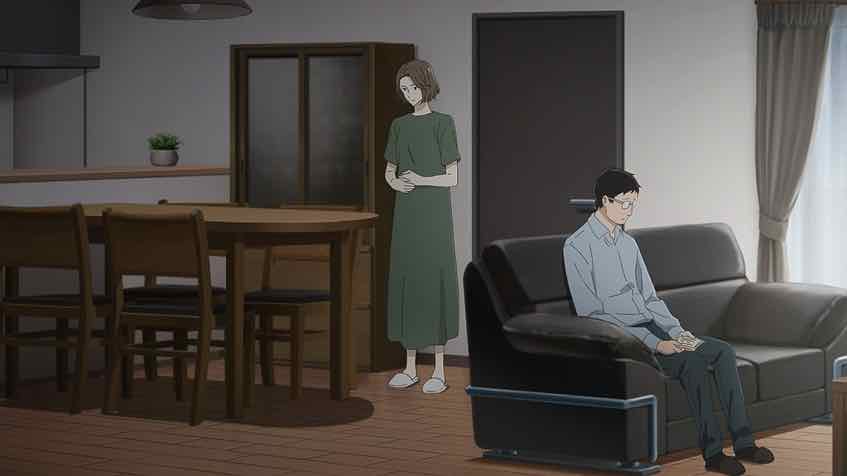
There’s a lot going on here. These characters are really layered and full of depth – not just the principals but the next circle, too. It’s unicorn-level writing in that sense, and as a character guy it’s the sort of writing that really ensnares me. But Ikoku Nikki is demanding as a result. As a viewer, and even more so as a critic. I can’t toss off instant reactions to this show, I have to really digest it and figure out what I just watched. And seeing a lot of myself in the protagonist (and I think Makio is that, when it’s all said and done) amplifies that even more.
That said, even by Ikoku Nikki standards this ep was seriously dense. There are two conversations taking place through much of the episode, with flashbacks and cut-aways fanning out from each. Shingo is talking with Nana, who’s reached out to him for help in finding a job (I presume). And Makio is meeting up with Michiko – Emiri’s mother – at a family restaurant. As to the first one, it’s becoming increasingly clear that Shingo is the sort of guy other people depend on – reliable, connected, seemingly centered. That has to be exhausting.
Hilariously, the first thing they say to each other is “How’s Makio?” – though of course for different reasons. Nana hasn’t talked with Makio in a while because that’s how introverts are with friends, and if they understand you they’re cool with it. Kasamachi-kun has of course, but he’s dying to know if Makio has been talking about him. Shingo and Makio are clearly edging closer together, but he’s taking the proverbial “she’s like a cat” eggshells approach. He confides to Nana (because you get the idea he’s been dying to confide to somebody) that he kind of fell apart emotionally when he and Makio broke up. And that’s not the sort of image people have of him.
Meanwhile Betty and Veronica are at the family restaurant too. But, being, fifteen, they won’t even sit at the same table as their “moms”. Asa is waxing on about how forgetful and disorganized Makio is – which kind of crosses the border into meanness, if you ask me – a charge Makio of course can’t deny. Emiri says the quiet part out loud, speculating that Makio might be neurodivergent, because to an extroverted 15 year-old anyone different must be (Asa has never heard of the term). Eventually the teeny boppers head off to buy a swimsuit and the adults get a little more personal in their conversation.
As you know, I’ve speculated that Michiko was going to prove a big problem – maybe even be the villain of the piece. But while that’s still on the table, it isn’t the vibe you get here. Makio is Makio – she doesn’t put on airs for anybody and I doubt she could even if she wanted to. But her frankness doesn’t seem to alarm Michiko as much as I’d feared. She’s just unsentimental by nature – she says flat-out she’s not Asa’s parent, she’s her guardian. She didn’t pay the dues her parents did – she doesn’t have skin in the game like they did. She also asks Michiko about her sister because the truth is, Michiko knew Minori better than Makio did.
Makio may not even be aware of it herself, but that she keeps asking about Minori betrays her fear that her assumptions may not have been entirely justified. The subject of regrets comes up – Michiko admits she has them, though also that they’re unavoidable. We finally – finally – get some background on Asa’s father (Yoshino Takahiro). Asa complained to Emiri that he never spoke up for himself or shared his opinion. And we learn, fascinatingly, that he and Minori were never married (Asa may not have known). He wanted to stick around and try to be a father, and Minori agreed. But this certainly implies that the two of them were never in love, or at least not for long (or that it was one-sided).
Minori’s perfect life was obviously not perfect. She was riddled with self-doubt and lied to her friends about her “husband”. Michiko notes that both sisters were hard on themselves, which takes Makio by surprise (it’s interesting to muse on why). Minori was a woman obsessed with normalcy; Makio one utterly unconcerned with it. This fact about the other drove both of them crazy. From Kasamachi’s conversation with Makio later we learn that he felt like his mother was trying to make him into a perfect son, which he never felt he could be. What could be more universal than all that?
As for the kids, their interactions are no less revealing. Asa notes that Emiri has been asked out by a boy – the latter is surprised she knows. Asa prods and prods – it’s what she does – even after it’s clear Emiri is uncomfortable on this topic. Asa doesn’t deny it when Emiri suggests she’s the one who wants a boyfriend, but Emiri’s reaction when Asa teasingly suggests she’d be happier with a girlfriend pretty much confirms that she’s interested in girls, not boys. Does that include Asa? It certainly seems possible, and if so that has the potential to be a serious challenge to their friendship, but let’s not get ahead of ourselves.
And finally, we have another journal – no, not Shingo’s mother’s bento one. The journal Makio found in the Takumi house and started to read says the plan was to give it to Asa when she turned 20. And Asa overhears Makio and Shingo debating how to handle that. Asa takes the bull by the horns and finds the diary on her own, but reading it gives her no satisfaction. She’s pissed at everyone – at Makio and Kasamachi-kun for hiding it, and especially at her mother (what about her father, one wonders) for dying. This could be a valuable window for Asa into her mother’s psyche – and may be, in time. But for now Asa is only concerned with what it isn’t, and that’s unassailable proof her mother loved her. That’s something Asa can never, ever have – and she’s somehow going to have to find the strength to live with that.