

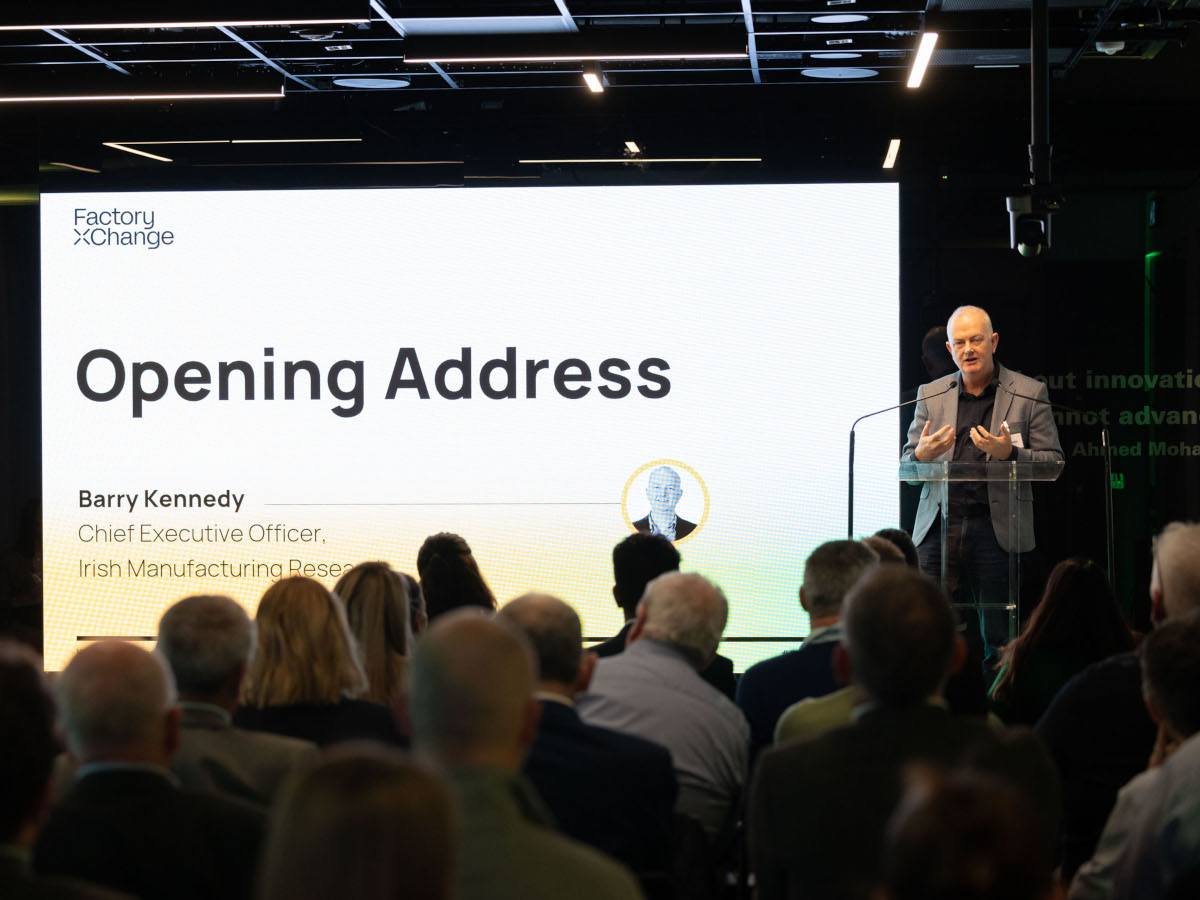

Kennedy goes in depth on IMR’s work in supporting manufacturers of all sizes in Ireland.
Manufacturers need to “get with the times”, as the saying goes. It’s obvious innovation fuels growth, but accessing and experimenting with new technology, while, at the same time, being unsure of its effectiveness on the shop floor, creates a few roadblocks for the businesses wanting to advance.
Barry Kennedy felt this needed to be rectified. “There was some fantastic research taking place in [Irish] universities, but it wasn’t translating out in any meaningful way at the rate it needed to be into manufacturing firms,” he says.
Not to mention, Ireland isn’t short of successful start-ups with innovative products ready to go into market, but manufacturers would hesitate to spend a huge capital if they can’t be sure how well it would work.
And testing new potential solutions on its own would be hugely disruptive to an already well-oiled production facility. This is especially an issue for small and medium-sized enterprises (SME) who can’t afford the break in production flow.
‘Factory of the future’
Kennedy, a former program manager at Intel, founded the Irish Manufacturing Research (IMR) after learning about similar, more late-stage organisations elsewhere in Europe – such as the Fraunhofer Institute in Germany or Tecnalia in Spain – that focus on getting new technology embedded into the industry.
The IMR launched in 2014 with €15m in funding and with just two employees. Styled after similar European institutions, and Ireland’s own Irish Centre for Manufacturing Research (ICMR) and Innovation for Ireland’s Energy Efficiency (i2e2) – both of which are also led by Kennedy – the IMR positions itself as an “honest gatekeeper in the middle”, Kennedy tells me.
“We demystify, de-risk and deliver emerging technologies for companies”. And a decade after launching, the institute now has around 140 people working across Ireland and Europe.
IMR offers a testbed for manufacturers to play with new technology, run trials and experiments, basically, offering a way for businesses to test before they commit. It also works with universities directly to create a roadmap to develop more industry-focused solutions. The organisation helps businesses discover what a “factory of the future” could look like, Kennedy tells me.
And as it turned out, manufacturers – from big names such as Johnson and Johnson, and Boston Scientific, to smaller ones, all wanted to get involved when the idea was first floated. In fact, Irish SMEs needed a lot more help innovating than multinationals, Kennedy quickly found out.
There’s more reasons to advance manufacturing in Ireland. According to the Central Statistics Office, the sector directly employs more than 220,000 people. It accounts for more than 34pc of Ireland’s GDP – more than double the European average of 15pc. In 2023, goods exports from Ireland reached €197.25bn, generating €13.7bn in wages.
Kennedy says that Ireland ranks 23rd globally when it comes to digitalisation and “way down the ladder” in more newer technologies such as robotics. Ireland only has 54 industrial robots per 10,000 employees in manufacturing, compared to Germany, which has 397 for every 10,000. Even the UK, which has slower in robotics and automation uptake, has 111, according to 2023 data.
On the other hand, the country offers between the ninth and eleventh highest average salary packages globally. Strong competitors such as the UK and South Korea are far down these ranks.
Essentially, Ireland has more expensive labour while being less advanced than its manufacturing competitors. “You can’t be the ninth most expensive on the planet and then hope to retain manufacturing unless you are running very efficiently,” Kennedy says.
From AI to sustainability
Take for example, Airbus, who wanted to find a way to detect defects on their aircraft wings that span anywhere from 20m to nearly 80m.
Speaking to Engineers Ireland last year, Kennedy explained that IMR took on this challenge, and alongside its European partners, developed an AI-powered robot that can accurately detect wings (unlike more traditionally robots that need to be veered into place) and spot defects.
This project was undertaken alongside an Irish company called Teg. “As part of that [the project], they [Teg] got a significant sum of money from the European Union”, Kennedy told Engineers Ireland. Following the project, Teg is now a tier two supplier into Airbus, meaning they can sell their products directly into the company.
IMR works across several other domains as well, including helping businesses design optimal layouts for their production floors. While in a completely different direction, the IMR helps with advanced 3D printing across several use cases, including printing practice organs for surgeons to improve patient outcomes.
Circular production, it turns out, is also one of IMR’s specialities. Kennedy gives an example of a local brewery that’s now able to utilise wasted bread from a bread making business nearby.
“It transcends all things from the food to the ICT to the bio-med to packaging and all that whole space,” Kennedy says. “The challenge here for businesses and industry is that in order to make this thing work, you need to be able to set up a supply chain and understand how this is all going to connect together.”
IMR leads the national circular economy platform, called Circuléire, where it’s bringing businesses together to figure this exact thing out. Launched in 2020, Circuléire is run by IMR and funded by the Irish Government. It is a public-private network that aims to demystify and drive circular business innovation in Ireland with more than 50 cross-sector members.
Pretty neat track record
I asked Kennedy if there was ever a problem the IMR wasn’t able to solve. Though taken aback a little at first, he says that while not every solution was a 100pc, there was no doubt that they were able to improve the situation. “You know, we’re taking on challenges that are not easy to solve,” he adds.
A testament to their success is FactoryXChange (FXC), a European Digital Innovation Hub (EDIH) led by the IMR focused on sustainable, human-centric manufacturing transformation. FXC is also supported by 17 expert partners across the country.
Last month, the project secured €2.3m in funding from the EU’s EDIH programme with an additional €3.4m matched by Enterprise Ireland to continue their work by offering up to 100pc discounted services.
FactoryXChange 1.0 supported over 495 Irish enterprises and public organisations SMEs to become more competitive in their business and production processes through digital transformation. With this funding, FactoryXChange 2.0 is set to help businesses by connecting them with advanced digital technologies, expert advice and funding to integrate ecological and digital solutions.
FactoryXChange’s funding application received the highest possible score from the European Commission, and was awarded the sought-after STEP seal of excellence this year.
“We were very successful in the first phase and…we scored 100pc in terms of the scoring for that particular programme [EDIH],” Kennedy says. “It’s kind of almost unheard of.
“We’re bringing in more service providers into the fold, so to speak, as we understand more about what the needs requirements are for the small and medium enterprises in this country.”
Don’t miss out on the knowledge you need to succeed. Sign up for the Daily Brief, Silicon Republic’s digest of need-to-know sci-tech news.