

Radioheliographs and wideband solar radio spectrographs are essential components of the Chinese Meridian Project (CMP)‐II (C. Wang et al., 2024) that aims to monitor the whole solar‐terrestrial chain of space weather events, from the lower solar atmosphere to near‐Earth space. This work introduce the CMP‐II radio instruments, including the MUSER‐L/I/H, the super‐wideband spectrographs of Mingantu and Chashan stations covering the wideband range of 30 MHz–15 GHz. The overall design, some technical details, the calibration method, and performance with some preliminary data of these instruments are presented.
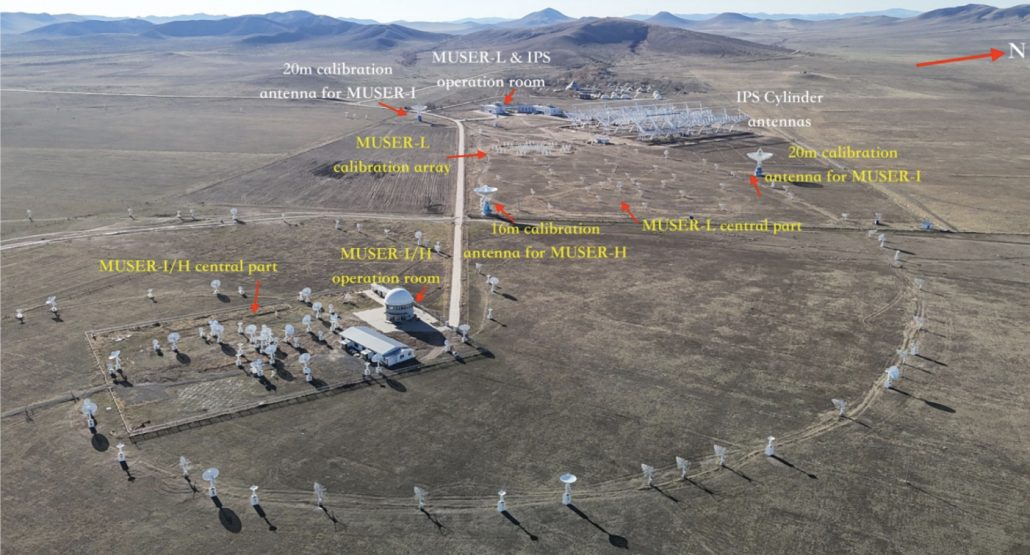
Figure 1. The panorama view of Mingantu Observing Station with MUSER‐H/I/L. arrays, calibration antennas.
The solar radio imaging spectroscopic instruments include a Meter–Decameter Wavelength Radioheliograph (30–400 MHz), the extension of MUSER to lower frequency range, a Circular Array Solar Radio Telescope (150–450 MHz) at Daocheng in Sichuan province (DART, J. Yan et al., 2023), and incorporate MUSER (Y. Yan et al., 2021), a Centimeter‐Decimeter Wavelength Radioheliograph (400 MHz–15 GHz) with new calibration system. The solar radio spectrometers include a Metric Wavelength Solar Radio Spectrometer (90–600 MHz) at Chashan in Shandong province (Chang et al., 2024), Decameter‐Metric to Centimetric Wavelength Solar Radio Spectrometers (30–400 MHz, 400 MHz–2 GHz, 2–15 GHz) at MUSER site, offering spectrum monitoring ability across a super wide band from 30 MHz up to 15 GHz. The super‐fine spectral structures of metric solar radio bursts are expected to be recorded. The data will be used to advance understanding of electron acceleration and emission mechanisms, and to improve early warnings of CME shocks and solar energetic particles. Figure 1 shows a panorama view of MUSER arrays and calibration antennas, etc., in the Mingantu Observing Station.
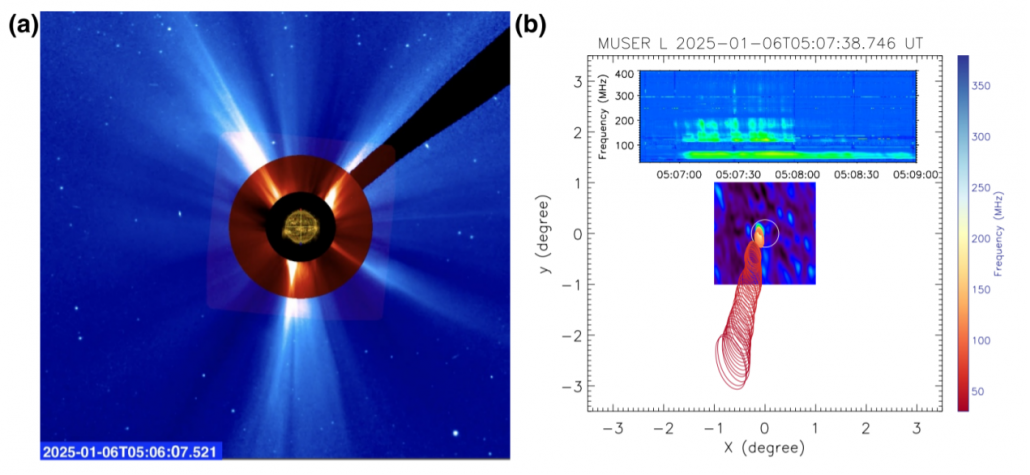
Figure 2. A burst event on 6 January 2025. (a) The LASCO/SOHO image at 05:06 UT. (b) The MUSER‐L multi‐frequencyimages in 30 MHz∼400 MHz at 05:07 UT. The inserted dynamic spectrum starting from 05:06 UT showing the enhancedsolar radio bursts.
With the newly established calibration systems for MUSER under CMP‐II and the new calibration method, further progress on solar radio imaging spectroscopy has been made. Various solar radio bursts have been recorded by MUSER‐L/‐I/‐H and Mingantu spectrometers. Data are transmitted to the CMP data center daily. A solar radio burst event occurred on 6 January 2025 and observed by MUSER‐L. The multi‐frequency images in 30 MHz – 400 MHz range were obtained and the radio source at 30 MHz was as far as over 10 solar radius. The multi‐frequency images in 30 MHz – 400 MHz range exhibit beam‐like cone structure with high frequency sources confined to the lower altitude close to the Sun, as shown in Figure 2. The alignment of these multi‐frequency radio sources at 05:07 UT agrees with the bright structure as shown by SOHO/LASCO C2 image around the same time period 05:06 UT. This event demonstrates the capacity to monitor solar eruptions from the Sun into interplanetary space.
The Chashan Broadband Solar radio spectrometer with high temporal‐spectral resolutions (<1 ms, 100 kHz) at meter wavelengths covering 90–600 MHz has been developed (CBSm, Chang et al., 2024). The major scientific purpose of CBSm is to record superfine spectral structures of metric solar radio bursts. See Figure 3 for examples of such spectral fine structures recorded by CBSm. Since 10 November 2022, CBSm has detected many solar radio bursts, including week‐long Type I bursts/noise storms, 50 Type II bursts, several thousand Type III bursts, and 20 Type IV bursts.
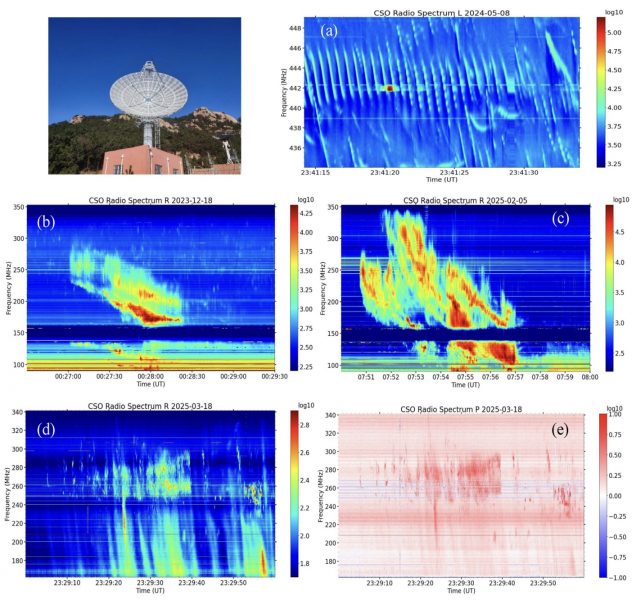
Figure 3. Top left panel is Chashan Solar Radio Spectrometer. (a) An example of stripes with an overall wavy morphology in the 8 May 2024 event, with beaded structure emerging in the middle portion (adapted from C. Li et al., 2025). (b) Type II bursts from 00:26:30 UT to 00:29:30 UT on 18 December 2023. (c) A type II burst from 07:50:00 UT to 08:00:00 UT on 5 February 2025.(d) Type III bursts from 23:29:00 UT to 23:30:00 UT on 18 March 2023. (e) Polarization degree corresponding to (d).
The data presented in this paper are available from the National Space Science Data Center for the Chinese Meridian Project ( Some data may be subject to a proprietary period; please refer to the data center’s access policy. MUSER event data can be visited at Local MUSER‐L data can be browsed at and CBSm data sets can be accessed at
Conclusions
The facilities described here offer uniquely broad frequency coverage and advanced imaging and spectral capability. Their open data policy will enable collaborative research and enhance global space weather monitoring and forecasting.
Additional info: The nugget is based on the recently published paper by Yihua Yan et al., 2025, Space Weather(open access), DOI:10.1029/2025SW004595
References
Chang, S., Wang, B., Lu, G., Shen, Y., Bai, Y., Shang, Z., et al. (2024). Development of a 90–600 MHz meter‐wave solar radio spectrometer. The Astrophysical Journal ‐ Supplement Series, 272(1), 21.
Li, C., Chen, Y., Wang, B., Zhong, Z., Tan, B., Ning, Z., et al. (2025). A novel fine spectral structure of solar radio bursts with periodic beaded stripes observed by CBSm of CMP‐II. Science China Physics, Mechanics & Astronomy, 68(10), 109611.
Yan, J., Wu, J., Wu, L., Yang, Y., Wu, J., Yan, Y., & Wang, C. (2023). A super radio camera with a one‐kilometre lens. Nature Astronomy, 7(6), 750.
Yan, Y., Chen, Z., Wang, W., Liu, F., Geng, L., Chen, L., et al. (2021). Mingantu spectral radioheliograph for solar and space weather studies. Frontiers in Astronomy and Space Sciences, 8, 20.
Wang, C., Xu, J., Chen, Z., Li, H., Feng, X., Huang, Z., & Wang, J. (2024). China’s ground‐based space environment monitoring network—Chinese meridian project (CMP). Space Weather, 22(7), e2024SW003972.